
What Is the Melting Point of Titanium? Complete Guide
Basic Information About Titanium
Titanium in the Periodic Table
Titanium has an atomic number of 22 and is a part of transition metals. It frequently occurs naturally in ilmenite and rutile. You use it in harsh conditions because of its dependable construction. The position of its reactivity is a point indicating a balanced reactivity. You would find it in common application where strength is required. Modern engineering still depends on titanium. It has a reliable performance that is advantageous to you.
Key Physical and Chemical Properties
Titanium has low density of approximately 4.5 g/cm 3. You have good strength-to-weight benefits. The metal is highly corrosion resistant in adverse environments. It can be trusted in marine and chemical conditions. It has a melting temperature of approximately 1,668C. You experience stability even at high temperature. Titanium enables you to get consistent results in serious applications.
Historical and Industrial Context
The first aerospace applications of titanium were Soviet projects in the 1950s and 1960s. Now you find it in the high-tech airplanes and spaceships. Its significance grew to medical implants and chemical processing. It is biocompatible and durable to your advantage. The industries rely on titanium to have a long service life. You can observe an increase in demand as technologies change. Titanium has remained influential in erudition of contemporary engineering.
What Is the Melting Point of Titanium?
Official Melting Point of Pure Titanium
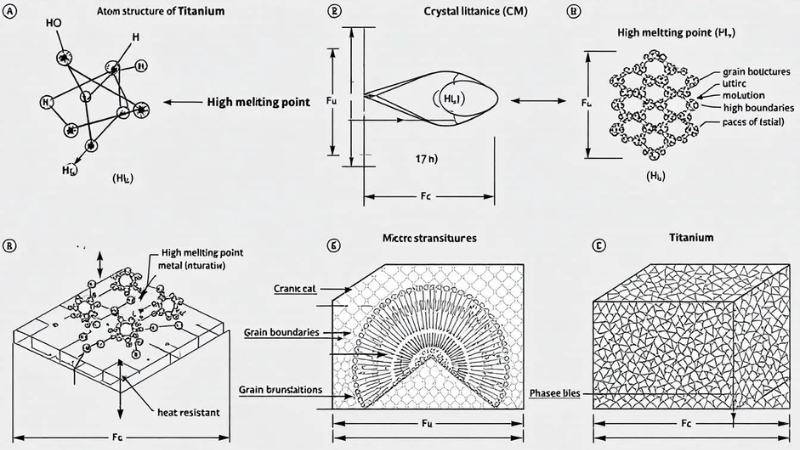
Pure titanium melts at 1725°C or 3135°F. This high melting point occurs in CP-Ti grades with low alloying content. These grades have more than 99 percent titanium, hence they provide consistent thermal characteristics. When using pure titanium, you get excellent heat resistance and a reliable performance. Its reliability can be trusted in its industrial or aerospace uses.
Why Melting Point Is Not a Single Fixed Number in Practice
In practice, melting point is not an absolute number since phase behavior is influenced by purity. Even minor impurities change ranges of melting. Minor changes in composition also alter the transition between solid and liquid materials. In industry, you might observe wider or more irregular ranges provided by uneven heating and increased batch size. Laboratory conditions provide a more exact control, however you still see small natural deviations.
Titanium Melting Point Compared to Other Common Metals
Metal | Category | Melting Point (°C) | Compared to Titanium (1668°C) |
Aluminum | Low-melting metal | 660°C | Much lower |
Lead | Low-melting metal | 327.5°C | Much lower |
Copper | Low-melting metal | 1084°C | Lower |
Brass | Low-melting metal | 930–1000°C | Lower |
Stainless Steel | Medium–high melting metal | 1230–1530°C | Slightly lower to moderately lower |
Cobalt | Medium–high melting metal | 1495°C | Lower |
Nickel | Medium–high melting metal | ~1455°C | Lower |
Thorium | Higher-melting metal | 1755°C | Slightly higher |
Vanadium | Higher-melting metal | 1910°C | Higher |
Rhodium | Higher-melting metal | 1963°C | Higher |
Iridium | Higher-melting metal | 2446°C | Much higher |
Tantalum | Higher-melting metal | 3020°C | Much higher |
Tungsten | Higher-melting metal | 3422°C | Extremely higher |
What This Comparison Reveals About Titanium’s Position
Titanium demonstrates how a metal can be subjected to high heat without getting hard to bend. You have the good balance between melting resistance and workability. It can be machined carefully, and still have the advantage of stability. This analogy will make you see why titanium occupies a distinct mid-refractory position.
Atomic and Crystallographic Reasons for Titanium’s High Melting Point
Atomic Structure of Titanium
At room temperature titanium remains in the α-phase and you have a stable HCP structure. This structure contains atoms closely and enhances stability of dimensions under stress. As temperature increases, titanium changes to the 3rd-phase which has a BCC lattice. You have greater atomic mobility and formability in this state. Strength and heat resistance are influenced by each change of phase. With this knowledge you could select the correct path of processing.

Strength of Metallic Bonding
Titanium is a metal with strong metallic bonds, which create high cohesion to your advantage. Such bonds enhance load bearing performance and heat resistance deformation. You can see firm bonding even on demanding uses. Titanium is maintained in shape when subjected to stress because of strong interatomic attraction. You achieve good structural performance in aerospace and industrial components.
Atomic Weight and Vibrational Energy
The high atomic mass of titanium decreases the vibration on the atomic level and you can observe improved stability. Reduced vibration implies that atoms require more energy to liberate. Before melting, you require more heat. The thermal resistance in critical tasks is also enhanced by this energy requirement. When machining or forging titanium, you acquire predictable behavior.
Valence and Electron Binding
Titanium has a valence of 4 and thus it has high electron bonding force. Tighter bonding increases the temperature energy required to melt the metal. You can observe high temperature strength retention. Stable electron interactions also increase rigidity in heavy loading. Titanium can be counted on to make high-performance parts.
Thermal Properties Related to Titanium’s Melting Behavior
Low Thermal Expansion
You have the advantage of low coefficient of thermal expansion materials. Reduced growth will provide accuracy in engineering and critical use. You do not have to make regular changes or replacements due to changes in temperature. The property is essential when tight tolerances are required.
Heat Resistance vs. Heat Conductivity
You get such materials combining moderate thermal conductivity and good heat resistance. They are strong in terms of mechanics at high temperatures. They can be used in those settings where the exposure to heat is uniform. This equilibrium avoids overheating but keeps performance intact.
Solid-State Strength Retention Before Melting
Solid-State Strength Retention Prior to Melting.
You observe that these materials are less likely to become weak with temperature increase as compared to most metals. You use them in high heat structural applications. When melting they are also free of defects, safe and durable. You get a good performance without losing strength.
Factors Affecting the Melting Point of Titanium
- Purity Level: Impurities like oxygen, nitrogen, hydrogen, and carbon can lower metal performance. You must consider that lower purity reduces effective melting point and ductility.
- Atomic Diffusion and Mobility: Atomic diffusion can alter melting behavior by changing how atoms interact under heat. You can observe variations up to ~450°C.
- Pressure Conditions: High pressure slightly elevates melting points in many materials. You should account for this in aerospace environments.
- Manufacturing and Processing History: Processes like cold working, annealing, and heat treatment impact melting behavior. You should evaluate grain structure for thermal and mechanical properties.
Melting Point of Common Titanium Alloys
Why Titanium Alloys Melt Differently from Pure Titanium
You need to know that alloying elements vary titanium phase transitions. Aluminum, vanadium or tin modifies its microstructure, and melting. The process of solid solution strengthening makes the metal harder whereas dispersion strengthening interferes with the process of deformation. The combination of these effects increases the melting range. These are differences that you should note during the melting, casting, or heat-treatment of titanium alloys.
Key Titanium Alloys and Their Melting Ranges
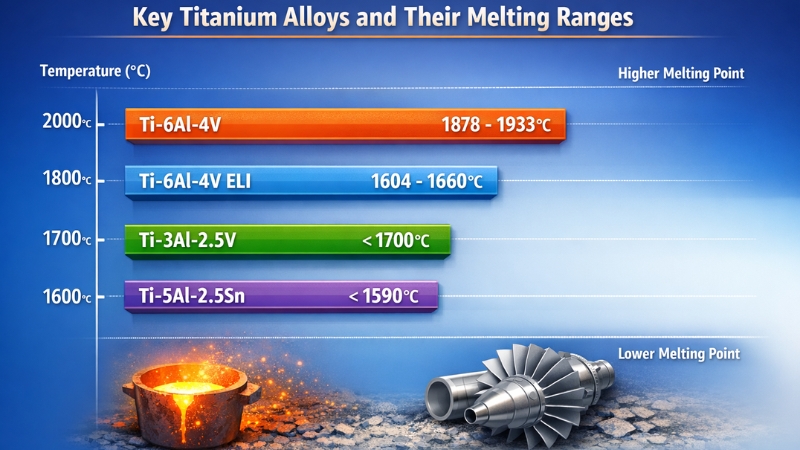
To get an idea on the thermal properties of common titanium alloys, you can make comparisons. The melting range of Ti-6Al-4V is 18781933 C and that of Ti-6Al-4V ELI is 1604-1660 C. Ti-3Al-2.5 V melts at a temperature of less than 1700 C and Ti-5Al-2.5Sn at a temperature of less than 1590 C. The melting behavior is different in each alloy because they contain a specific alloy. In your application, you need to choose alloys depending on their performance during heat and mechanical conditions.
Role of Aluminum, Vanadium, and Tin
You have to understand that the alpha phase is stabilized through aluminum, making the material stronger and heat resistant. Vanadium stabilizes the beta phase enhancing ductility and toughness. Tin increases creep strength at high temperatures. These factors can be manipulated to customize alloys to selected mechanical and thermal characteristics. Alloy composition should be maximized to suit purpose.
Titanium as a Refractory and High-Temperature Material
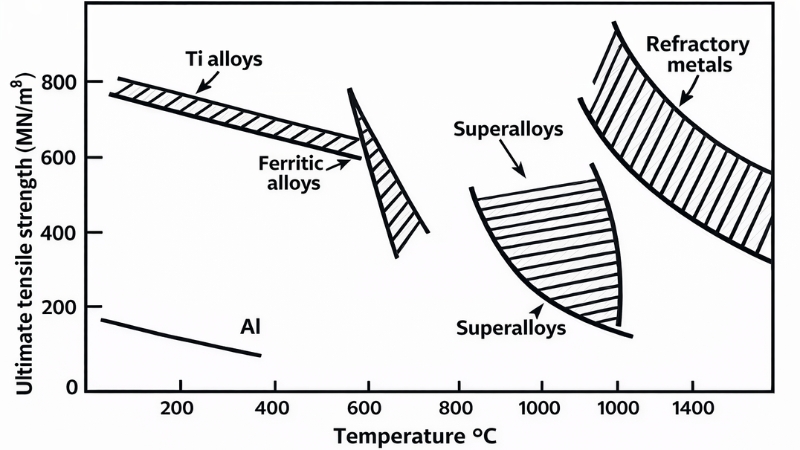
Refractory metals are metals which you can depend on when the temperatures are extreme. You will find that they melt at very high points. They can be used in areas where heat resistance is crucial. These metals are also highly wear resistant. Their mechanical stress stability is advantageous to you. You can use them in aerospace, electronics, and industrial tools. They are durable hence will perform well over time even in rough environments. They can be chosen to do jobs that involve strength and thermal endurance.
Titanium’s Qualification as a Near-Refractory Metal
Titanium being a high melting temperature metal, above 1600 o C, can be classified as a near-refractory metal. It can withstand high-temperature situations and will not lose structural integrity. Its great resistance to oxidation is of advantage when alloyed, or under proper protection. Titanium can be trusted in stressful applications that need toughness.
Advantages Over Traditional Refractory Metals
You will discover this material is a very low-density one compared to tungsten or tantalum. This renders it much easier to handle and transport. It can be machine-machined without excessive machinery, such as ultra-high-melting metals. You save time and costs when fabricating. Its ease of work gives you the opportunity to get the right shapes accurately.
Industrial Applications That Rely on Titanium’s High Melting Point
Aerospace and Aviation
You use state-of-the-art materials to get jet engine components that are very safe and efficient. Compressor components and turbine blades should be able to tolerate extreme temperatures and high rotation loads. The structural components of the airframe make them strong and lightweight at the same time. In the 1950s-1960s aerospace period of the Soviet era, designers used tough designs. These historic roots in aerospace today are helpful to you.

Turbine and Power Generation Systems
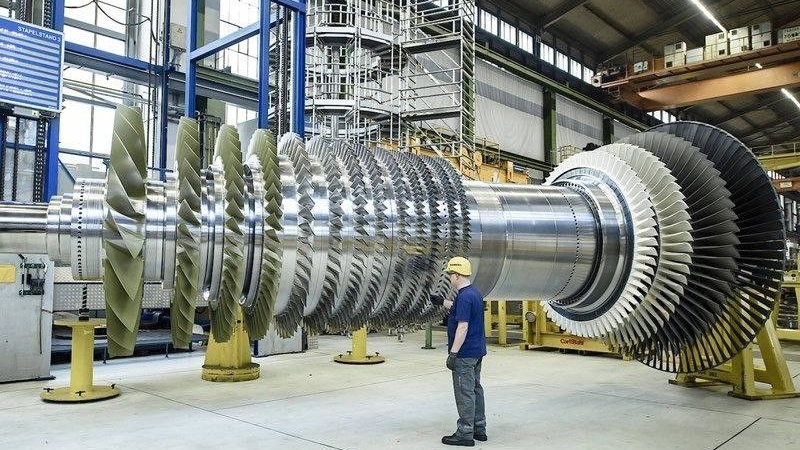
You need turbine components that resist prolonged high-temperature stress during operation. Materials must remain stable under continuous rotation and mechanical load. Rotors, shafts, and critical moving parts require durability to prevent failure. You gain higher efficiency and longer service life by selecting alloys that tolerate extreme thermal cycles. These materials also reduce downtime and maintenance frequency.
Heat Exchangers and Thermal Equipment
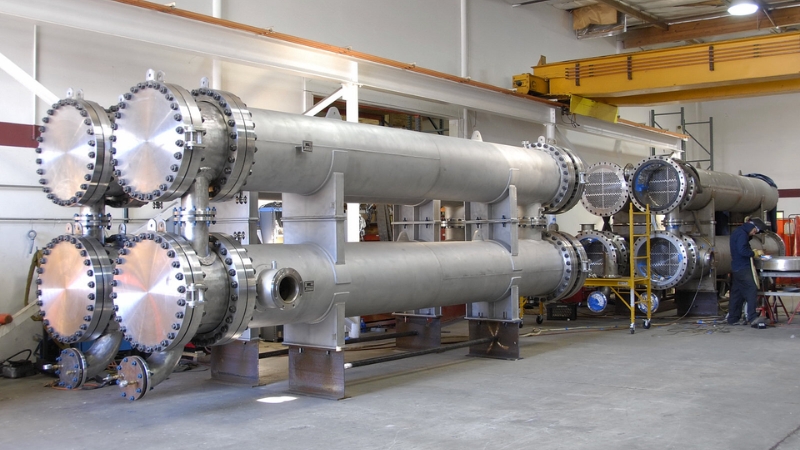
You are using titanium tubes and shells in chemical and marine heat exchangers. These parts manage fluids that are corrosive at high temperatures. Corrosion-resistant materials can be used to minimize maintenance and stop leaks. Effective heat transfer requires alloys which do not deform under pressure. You have durable and dependable thermal systems using well selected parts.
Chemical Processing Industry
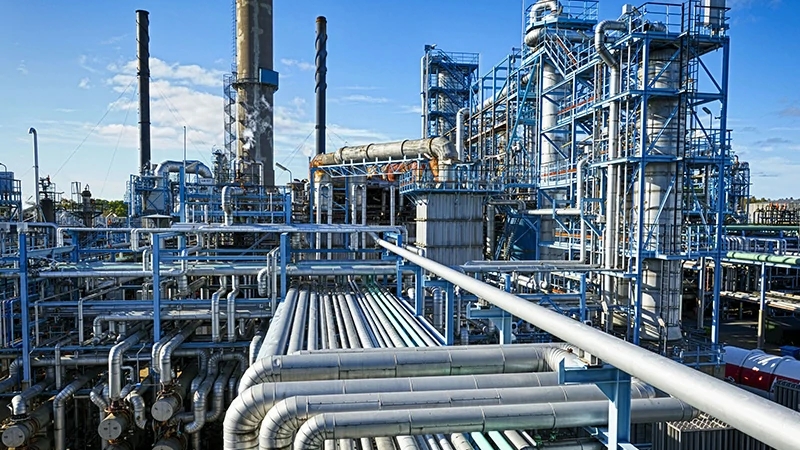
You require heat and corrosion resistant reactors, piping and pressure vessels. Chemical processes require materials that do not disintegrate in severe conditions. High-strength alloys are safe in transporting reactive fluids. These elements reduce risk but provide operational efficiency. You prevent the loss of equipment and human life by daily processing the appropriate metals.
Medical and Biotechnical Applications
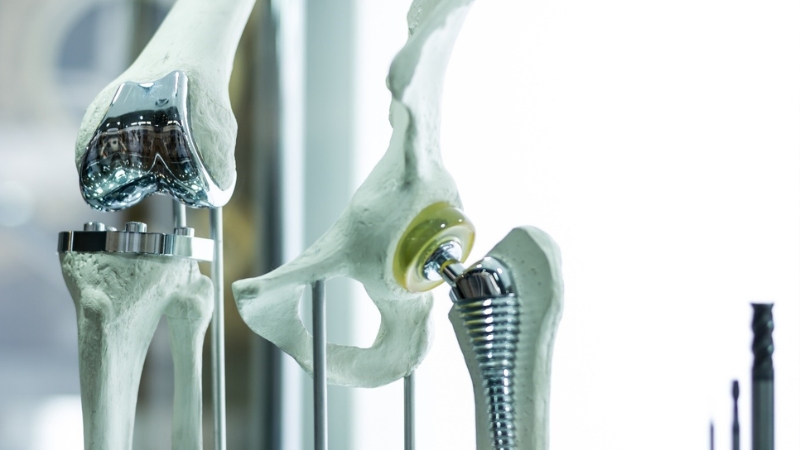
You need materials that can stand multiple sterilization of surgical equipment and implants. The high-temperature resistance guarantees the long-term dependability without fatigue of materials. The biocompatible alloys enable interaction with the human tissue safely. These materials can be relied upon to ensure accuracy and stability in medical practice. Adequate selection ensures safety of the patient and uniformity of performance in the operation.
Automotive and Performance Engineering
You have the advantage of lightweight powerful engine parts, which enhance the performance of the vehicle. Materials decrease the total weight but do not diminish the strength at stress. It allows you to come up with better, safer engines that are faster and more efficient. Metallic alloys of high performance enable superior heat resistance and longevity in challenging environments. You get optimized power-to weight ratios and increased fuel efficiency.

Manufacturing Implications of Titanium’s Melting Point
Casting Challenges
Special furnaces are required when you are dealing with metals that have high melting points. Activation becomes more intense at high temperatures. The environment must be carefully regulated to prevent the oxidation and undesired reactions. These challenges are controllable by using proper fluxes and molds. Knowledge of thermal gradient leads to improved quality of casting. You have to schedule cooling rates to minimize defects such as cracks and porosity.
Forging and Hot Working
You need to operate within the best temperature ranges that are less than the melting points. Metal properties are influenced by phase changes. Strain rates should be carefully controlled during deformation. To ensure strength, you need to observe changes in microstructure. Defects on the surface are prevented by proper tooling. Final mechanical performance is affected by cooling techniques. You should also choose lubricants that minimize wear and friction.
Welding and Joining
Oxidation and contamination should be avoided by using inert atmospheres. Inclusions are affected by high temperatures. Always clean up the surfaces well before joining. Heat supply control to prevent warping. Correct choice of fillers gives good joints. Observation of intermetallic formation enhances strength. You must also have preheating plans to reduce thermal stress and cracking.
Titanium Alloy Optimization and Supplier Considerations
Alloy Design and Customization
You are able to customize alloy compositions to certain melting points to suit your projects. With the manipulation of elements, you can have a balance of strength, corrosion resistance, and thermal stability. This enables the material to be used in extreme conditions. With professionals, you attain alloys that suit their specific demands without affecting performance.
Precision Manufacturing
You have the advantage of using advanced casting, forging and machining methods to manufacture quality components. All components have tight tolerances to dimensions and mechanical integrity. The process of precision manufacturing permits intricate shapes and maintains strength and thermal stability. With the ability to control every process, you gain reliability, lower the error rate, and attain reliable performance of demanding applications.
Quality Assurance
You also check your chemical composition with spectrographic analysis. Tensile testing validates strength and ductility requirements on the alloy. Previous standards such as ASTM, ISO, and AMS ensure international acceptance. Regular testing avoids failures and safeguards your investment. These materials will give you the confidence of using materials of high quality.
Choosing a Reliable Titanium Supplier
You must certify material and traceability of each batch. Effective technical assistance helps you in the choice of apposite alloys. Make sure that the supplier has the ability to produce at scale when large-scale orders are demanded. A trusted partner offers quality services, professional advice, and high-quality delivery, which makes your projects easier and completely predictable throughout the whole process.
Conclusion
You are able to value the high melting point of titanium and its importance in the contemporary industry. Its functionality varies with purity, alloy composition, processing, and pressure. It is important to note that all these factors impact directly on strength, durability, and heat resistance. Titanium can withstand high temperatures and can be used where precision is required and it is better than most of the other metals. It is the number one choice in aerospace, medical implants, automotive components, and chemical processing, because it is not matched by other materials in terms of strength and corrosion resistance. Knowing these facts assists in choosing titanium to use in challenging high-performance applications.